



What if the patterns that hold you back, the looping thoughts and reactive habits that leave you feeling stuck, aren’t permanent parts of who you are? What if they are simply learned responses, like a well-worn path in a forest that can be gently rerouted toward a sunnier clearing?
It’s an exhausting cycle to be caught in, where the world of therapy can feel overwhelming with its clinical jargon and complex theories. You know a change is needed, but the path forward often seems unclear, leaving you feeling disconnected from your own inner power and frustrated by the lack of simple, effective tools.
This guide is designed to be your clear, supportive map back to yourself. We will explore practical, science-backed behavioral therapy techniques that empower you not just to cope, but to understand the “why” behind your actions. You’ll discover how to reshape your habits, calm your nervous system in moments of stress, and reclaim a profound sense of mental vitality. Together, we will translate these powerful concepts into daily practices you can use to restore your natural harmony.
Key Takeaways
- Learn the core principle that habits are learned behaviors, meaning they can be consciously reshaped to restore your inner balance.
- Implement practical behavioral therapy techniques, such as Behavioral Activation, to re-engage with life’s joys and combat persistent low mood.
- Understand the science behind “faking it till you become it” to overcome initial resistance and make new, positive actions feel authentic.
- Explore the crucial link between physical wellness and mental vitality, and why a balanced diet is essential fuel for sustainable change.
What is Behavioral Therapy? Understanding the Path to Change
In the journey toward mental and emotional balance, we often look inward, searching for the deep-seated roots of our distress. While this is a valuable part of healing, behavioral therapy offers a different, more direct path. It operates on a beautifully simple premise: our actions, habits, and reactions are learned, and therefore, they can be unlearned or reshaped. Instead of focusing exclusively on the internal world of thoughts and feelings, this approach targets the observable behaviors that contribute to anxiety and stress. It asks not just “Why do I feel this way?” but also “What can I do right now to change my response and restore my equilibrium?”
This action-oriented philosophy distinguishes it from traditional talk therapy. It’s less about excavating the past and more about building a functional, resilient present. The world is taking notice of this practical approach. As our lives become increasingly digital, the demand for accessible mental wellness tools is accelerating. Projections from Global Market Insights indicate the digital mental health market will surpass $20 billion by 2026, with a significant portion driven by apps and platforms based on self-led behavioral therapy techniques. This shift reflects a collective desire for strategies that empower us to make tangible changes, fostering a sense of control and vitality in our daily lives.
The Core Principles of Behavioral Modification
At its heart, behavioral therapy is rooted in well-established principles of learning. It recognizes that our responses are often shaped by two key processes: classical and operant conditioning.Classical conditioning creates associations; for example, the specific sound of a work notification might become a trigger for an immediate stress response.
Operant conditioning, on the other hand, involves consequences. If avoiding a social situation temporarily reduces anxiety, that avoidance behavior is reinforced, making it more likely to happen again.
A deeper exploration into Understanding Behavior Therapy reveals how these learning mechanisms form the bedrock of our habits, both helpful and harmful.By identifying these patterns, we can begin to dismantle the cycles that keep us stuck and intentionally cultivate responses that lead to peace and well-being.
The focus is always on the “now” because immediate action provides the most direct route to relief and lasting change.
Who Can Benefit from These Techniques?
The applications of these practical tools are incredibly broad, offering a pathway to relief for many common challenges.Individuals struggling with generalized anxiety, specific phobias, panic attacks, and chronic stress often find significant improvement by applying structured behavioral strategies. These methods provide a clear framework for confronting fears and rewiring the body’s alarm system.
But their utility doesn’t end with clinical conditions. Anyone seeking greater personal harmony and self-improvement can benefit.These behavioral therapy techniques can help you build healthier routines, overcome procrastination, and enhance your overall vitality.
It’s important to remember, however, that for severe conditions like major depressive disorder or complex trauma, these tools are best used under the guidance of a qualified mental health professional who can provide a comprehensive and personalized treatment plan.
The Science of Habit: How Our Brains Relearn Vitality
Your brain isn’t a static organ, forever fixed in its ways. It’s a dynamic, living network capable of profound change. This remarkable ability is known as neuroplasticity, the brain’s inherent power to reorganize its own structure and function in response to new experiences and actions. When you feel trapped in a cycle of anxiety, you aren’t fighting a permanent state; you are contending with deeply ingrained neural pathways, which are essentially well-worn roads that your thoughts and reactions travel automatically.
Think of these pathways like trails in a forest. The more a specific thought pattern or behavioral response is repeated, the more defined that trail becomes, making it the default route for your brain.Over time, these repetitive anxious responses—worrying about the future, avoiding social situations, or constantly checking for reassurance—strengthen the very circuits that perpetuate unease.
This isn’t just a mental phenomenon. Each time an anxious trigger is encountered, it can activate the body’s sympathetic nervous system, releasing a cascade of stress hormones like cortisol.
A 2013 study in Psychoneuroendocrinology found that individuals with anxiety disorders can have significantly higher baseline cortisol levels, disrupting the body’s natural equilibrium, or homeostasis.
The goal of effective behavioral therapy techniques is to consciously carve new, healthier trails, weakening the old ones until they become overgrown and forgotten.
The Habit Loop: Trigger, Action, Reward
At the heart of this neurological process is a simple, powerful mechanism. The habit loop is the neurological blueprint of our automatic behaviors, a three-step cycle of trigger, action, and reward that our brain follows to conserve energy. A “trigger” might be an environmental cue like the sound of a specific ringtone or the feeling of being in a crowded space. The “action” is the anxious behavior that follows. The “reward” is often a temporary sense of relief, which unfortunately reinforces the entire loop, making it more likely to happen again.
Why “Willpower” is Not Enough
Simply trying to “power through” anxiety with willpower often fails because it works against your brain’s fundamental wiring.Willpower is a finite resource, and battling deeply embedded neural pathways with sheer mental force is exhausting and often unsustainable.
Lasting change requires a smarter approach that combines mental insight with a behavioral framework. As explained by the National Institutes of Health in their overview on the Science of Cognitive Behavioral Therapy, it’s the interplay between our thoughts and actions that truly reshapes our physiological responses.Instead of relying on willpower, we can use environmental design—like turning off work notifications after 7 PM to remove a trigger—to make healthier choices easier.
Small, incremental changes, when practiced consistently, create significant, long-term physiological shifts, restoring your body’s natural harmony.Understanding these mechanisms is the first step toward reclaiming your inner balance.
For those seeking to support their body’s natural stress response, exploring our collection of adaptogenic herbs can be a powerful complement to these behavioral shifts.

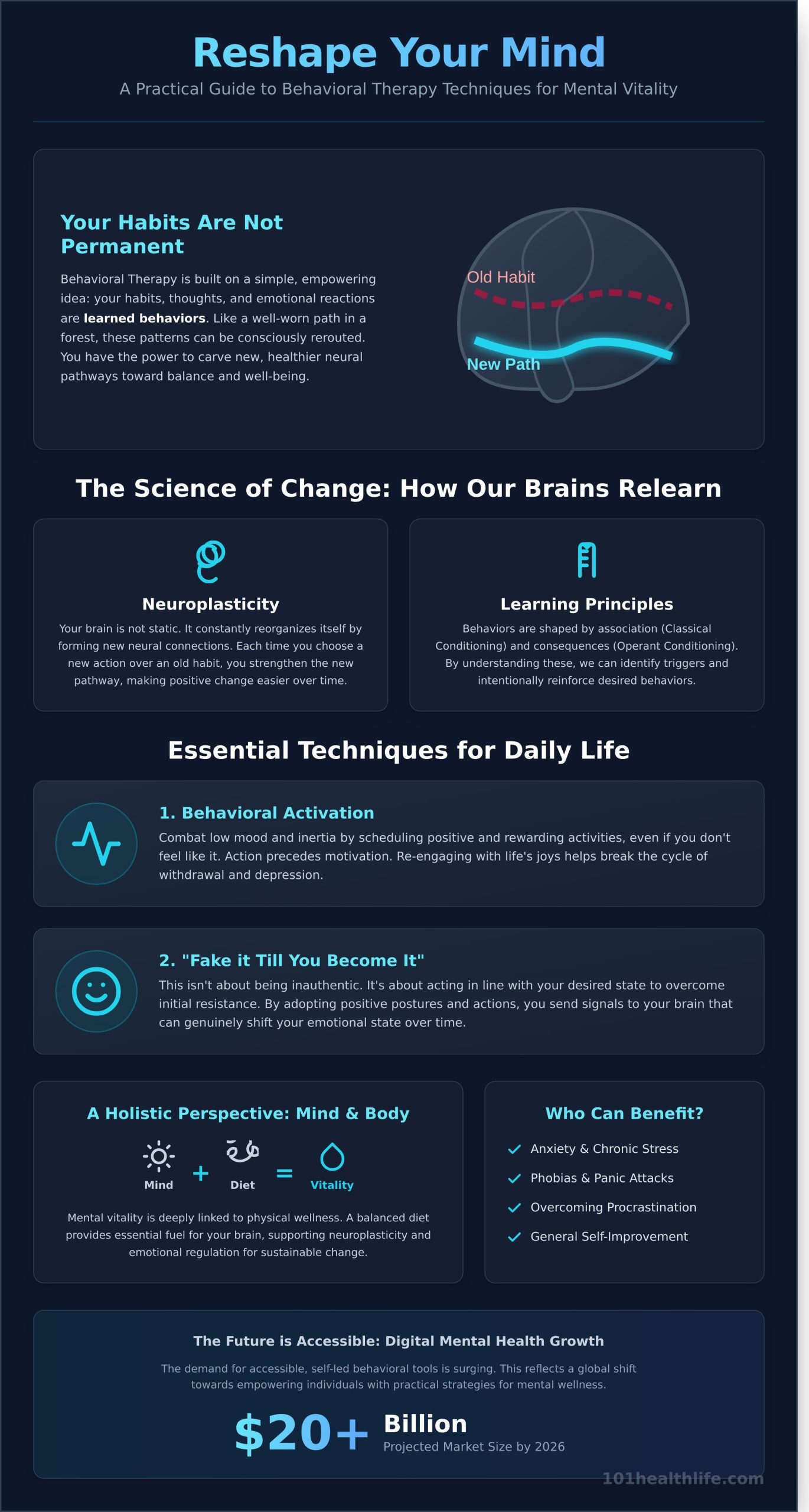
5 Essential Behavioral Therapy Techniques for Daily Life
Understanding the roots of anxiety is the first step; actively reshaping our daily habits is the journey toward lasting calm. The mind and body exist in a delicate balance, and our actions directly influence our internal state. By integrating specific behavioral therapy techniques into your routine, you can gently guide your nervous system back to a state of equilibrium. These practical strategies are cornerstones of modern psychology, and the core principles of Behavioral Therapy Techniques are designed to empower you to become an active participant in your own healing. Let’s explore five foundational methods you can start using today.
1. Systematic Desensitization: A Gentle Approach to Fear
This technique helps you slowly and safely face your fears, rather than avoiding them. Avoidance can provide temporary relief, but it often reinforces the anxiety in the long run. By gradually exposing yourself to a stressor in manageable steps, you teach your body that it can handle the situation without triggering a full-blown fight-or-flight response. It’s a process of retraining your body’s alarm system.
Applying Exposure Therapy at Home
The key is creating a “fear hierarchy”-a list of situations related to your fear, ranked from least to most intimidating. For a common 2026 stressor like digital burnout, your hierarchy might start with turning off phone notifications for 30 minutes and build up to a full day offline. The goal is to stay in each situation until your physical anxiety symptoms decrease by at least 50%, proving to your nervous system that the perceived threat is not real.
2. Behavioral Activation: Re-engaging with Vitality
When we feel anxious or low, our natural inclination is to withdraw. Behavioral activation directly counters this by scheduling positive and rewarding activities back into your life, even if you don’t feel motivated. Action precedes motivation. This process helps restore the flow of natural mood-boosters like dopamine, rebuilding your energy and sense of purpose from the outside in.
Behavioral Activation for Energy and Mood
Start by scheduling two types of activities: “pleasure” (a walk in nature, listening to music) and “mastery” (organizing a drawer, cooking a simple meal). A 2024 study in The Lancet Psychiatry found that just 15 minutes of brisk walking can reduce anxiety symptoms for hours. Break larger goals into “micro-actions”-instead of “clean the house,” the goal becomes “wipe down one kitchen counter.” This prevents overwhelm and creates consistent wins.
3. Cognitive Reframing: Shifting Your Inner Narrative
While a cognitive technique, reframing is essential for supporting positive behavior. It involves identifying an unhelpful thought that’s preventing action and replacing it with a more balanced and empowering one. The thought “I’m too anxious to go to the store” can be reframed as, “The feeling of anxiety is uncomfortable, but I am capable of going to the store for 10 minutes.” This small shift in perspective can unlock the behavior you wish to perform.
4. Self-Monitoring: Becoming Aware of Your Patterns
To change a behavior, you must first understand it. Self-monitoring involves tracking your actions, moods, and triggers. In 2026, this is easier than ever with journaling apps like Daylio, but a simple notebook works just as well. By logging your experiences for as little as 14 days, you can uncover powerful connections. You might discover your anxiety peaks after consuming caffeine or that your mood improves significantly after short bursts of physical activity. This awareness is the foundation for targeted change.
5. Token Economies: Creating Personal Reward Systems
This technique uses positive reinforcement to build and maintain healthy habits. It’s about creating a personal system where you earn “tokens” for completing desired behaviors, which can then be exchanged for a meaningful reward. For instance, for every day you practice a 5-minute meditation, you give yourself a point. After earning 25 points, you treat yourself to a new book or a visit to a botanical garden. This process makes habit formation feel rewarding and sustainable, strengthening the new neural pathways in your brain.
Overcoming Resistance: Making Change Feel Natural
Embarking on a journey with behavioral therapy techniques often brings an unexpected challenge: the feeling of inauthenticity. When you consciously choose a new response to an old trigger, your mind might protest, “This isn’t me. I’m just faking it.” This resistance is a completely normal part of rewiring deeply ingrained neural pathways. It’s the friction that occurs when a new, healthier habit pushes against the well-worn groove of an old, anxious one. The key is to understand this discomfort not as a sign of failure, but as evidence that change is actively happening.
The principle of “act as if” is a cornerstone of behavioral science. It suggests that by adopting the behaviors of the person you wish to become, you can actually influence your internal state. Research published in the Journal of Personality and Social Psychology has consistently shown that our actions can shape our emotions and beliefs, not just the other way around. When you choose to breathe deeply instead of panicking, you are not faking calmness; you are actively teaching your nervous system a new, more balanced response. Each repetition strengthens this new connection until it becomes your natural default.
As you commit to these new behaviors, you may experience something psychologists call an “extinction burst.” This is a period where your anxiety or old habits seem to get worse right before they get better. It’s your brain’s last-ditch effort to revert to what’s familiar. Imagine your anxiety is used to getting a specific reaction from you, like avoidance. When you stop providing that reaction, the anxiety may “shout louder” for a short time to try and get its way. Recognizing this phase for what it is-a sign that the old pattern is losing its power-can help you persist through the temporary spike in discomfort.
Mindfulness is the essential tool that creates a bridge between a trigger and your reaction. It cultivates a moment of pause. In that brief space, you reclaim your power of choice. Instead of a knee-jerk anxious reaction, you can observe the feeling, take a conscious breath, and choose a behavior aligned with your goal of inner harmony. This simple act interrupts the automatic pilot of anxiety and puts you back in control.
Dealing with Setbacks and Relapses
From the 101 Health Life perspective, a “slip” is not a failure of character; it is a valuable data point on your path to well-being. Setbacks are inevitable in any meaningful transformation. Instead of self-criticism, view these moments as opportunities to refine your strategy. What was the trigger? What internal or external resources were lacking? Patience and self-compassion are your greatest allies here, reminding you that healing is a process of gentle, persistent effort, not perfect performance.
The Role of Social Support
Sharing your goals can powerfully reinforce your commitment. A 2015 study by the American Psychological Association found that individuals who shared their progress with a friend had a 76% higher success rate in achieving their goals. In our digital age, this doesn’t have to mean stressful public declarations. A simple, private check-in with a trusted partner or a small group can provide accountability. If resistance feels overwhelming, it may be time to seek a professional who can provide guided support with advanced behavioral therapy techniques.
To build a foundation of resilience that supports your journey toward lasting change, explore our expert-curated guide to holistic stress management strategies.
A Holistic Perspective: Integrating Behavior with Physical Wellness
True and lasting anxiety relief doesn’t happen in a vacuum. The most effective behavioral changes are built upon a foundation of physical well-being, recognizing that our mind and body are not separate entities but a single, interconnected system. The success of the cognitive and behavioral work you do is directly influenced by the physiological state of your body. Think of it as preparing fertile ground before planting a seed; your physical health is the soil in which mental harmony can grow.
This bidirectional relationship is crucial. Just as chronic stress can manifest in physical ailments, a body that is undernourished or poorly rested will struggle to support the cognitive effort required for change. This final step is about closing the loop, integrating your new behavioral skills with the pillars of physical health to create a self-reinforcing cycle of vitality.
Nutrition as a Behavioral Foundation
The food you consume directly fuels your brain’s ability to regulate mood and execute new behaviors. Unstable blood sugar, often caused by processed foods and refined sugars, is a primary saboteur of emotional stability. A 2019 meta-analysis in Psychosomatic Medicine confirmed a significant link between high-sugar diets and an increased risk of depression. These fluctuations can trigger irritability and impulsivity, making it far more challenging to practice patience and mindfulness. Building neurological resilience starts with a foundational balanced diet and nutrition pillar, providing the raw materials for a stable mind.
- Omega-3 Fatty Acids (DHA & EPA): Found in fatty fish and algae, these are critical components of brain cell membranes and support neuroplasticity.
- B-Vitamins (especially B6, B9, B12): These are essential for producing neurotransmitters like serotonin and dopamine, which are central to mood regulation.
- Magnesium: This mineral helps calm the nervous system and is involved in over 300 biochemical reactions in the body, including stress response modulation.
The Behavioral Side of Stress Management
Beyond diet, specific physical practices can be used as powerful behavioral tools to manage the body’s stress response directly. These techniques signal safety to the nervous system on a primal level, creating an internal environment where anxiety struggles to take hold. Progressive Muscle Relaxation (PMR), developed by Dr. Edmund Jacobson in the 1920s, involves systematically tensing and then releasing different muscle groups. This simple act teaches you to recognize and release physical tension, actively telling your parasympathetic nervous system to take over from the “fight-or-flight” response.
Breathing techniques serve as a “behavioral anchor” in moments of acute stress. When you intentionally slow and deepen your breath, as with the 4-7-8 method (inhale for 4, hold for 7, exhale for 8), you directly influence your heart rate variability (HRV). Higher HRV is a key physiological marker of a resilient nervous system. Through the consistent practice of these physical habits, you achieve a state of holistic vitalization where your body and mind work in concert.
Ultimately, integrating these physical wellness practices transforms the application of behavioral therapy techniques from a mental exercise into a fully embodied experience. When your mind is calm, your body reduces its production of the stress hormone cortisol, which research from a 2012 study in PNAS has linked to accelerated cellular aging. By fostering mental harmony, you are not only finding relief today but also investing in your physical longevity for all your tomorrows.
Cultivating Your Inner Harmony, One Step at a Time
The journey to inner balance isn’t a mystery; it’s a skill you can cultivate. By understanding how your brain’s neuroplasticity, as confirmed by decades of research from institutions like the National Institute of Mental Health, supports new habits, you’ve taken a critical first step. The 5 daily practices we explored are foundational tools for rewiring your responses to stress and building lasting resilience. This integration of mind and body is the cornerstone of true wellness.
These powerful behavioral therapy techniques are more than just psychological tools; they are a bridge to a more conscious and balanced life. Your path doesn’t end here. It’s an ongoing practice of mindful living. For more expert-reviewed health guides and evidence-based wellness insights focused on natural, sustainable lifestyle changes, we invite you to explore more ways to achieve holistic balance at 101 Health Life.
Remember, every small step you take today builds the foundation for a more vibrant and harmonious tomorrow. Your well-being is a journey, not a destination.
Frequently Asked Questions About Behavioral Therapy
What is the most effective behavioral therapy technique for anxiety?
Exposure therapy is widely considered one of the most effective techniques, particularly for phobias, panic disorder, and OCD. Studies from the American Psychological Association show it has a success rate between 60% and 90% for specific phobias. This method involves gradual, controlled exposure to a feared situation to reduce the associated anxiety response. However, the “best” technique is always the one that aligns with your specific needs and helps restore your personal sense of harmony.
Can I practice behavioral therapy techniques on my own without a therapist?
Yes, you can practice many foundational techniques on your own, such as deep breathing or progressive muscle relaxation, to manage mild anxiety. Self-help workbooks can also provide structured guidance. For more complex issues or techniques like exposure therapy, professional guidance is crucial. A therapist ensures you’re applying the methods safely and effectively, providing support and adjustments to help you achieve a stable, long-term balance in your well-being.
How long does it take for behavioral therapy to start working?
Many people begin to notice initial improvements in their anxiety symptoms within 4 to 6 weeks of consistent practice and weekly sessions. More substantial and lasting change typically becomes evident after 12 to 20 sessions. Remember, this is a process of re-establishing your body’s natural equilibrium. The pace is unique to each person and depends on the specific challenges being addressed and the commitment to practicing the new skills between sessions.
What is the difference between CBT and behavioral therapy?
Behavioral therapy is the foundation, focusing directly on changing unhelpful behaviors through methods like conditioning. Cognitive Behavioral Therapy, or CBT, is a broader approach that includes these behavioral therapy techniques but also addresses the underlying thoughts, feelings, and beliefs that drive them. CBT works on the principle that by changing negative thought patterns, you can change your behavioral responses and find greater emotional balance.
Is behavioral therapy the same as “brainwashing” or forced change?
No, behavioral therapy is a collaborative and empowering process, not a form of coercion. The entire framework is built on your active participation and consent. You work together with a therapist to identify goals and choose strategies that feel right for you. The focus is on providing you with tools and understanding to make your own conscious changes, gently guiding your system back toward its natural state of health and calm.
How do I know if a specific behavioral technique is right for me?
The right technique is one that directly addresses your specific type of anxiety and feels manageable for you. For instance, if you experience social anxiety, role-playing exercises in a safe environment might be beneficial. If generalized worry is your main concern, relaxation techniques could be a better starting point. The most effective way to determine this is through a consultation with a mental health professional who can assess your unique situation and recommend a personalized path.
Can behavioral therapy help with physical health issues like insomnia?
Absolutely. A specific modality called Cognitive Behavioral Therapy for Insomnia (CBT-I) is the first-line treatment recommended by the American College of Physicians for chronic insomnia. Research published in the Annals of Internal Medicine in 2016 confirmed its high efficacy, helping 70-80% of patients. It uses techniques like stimulus control and sleep restriction to correct behaviors that disrupt the body’s natural sleep rhythms, promoting deep, restorative rest.
What should I do if I feel like my behavioral changes aren’t sticking?
It’s completely normal for progress to fluctuate; healing isn’t a linear path. If you find old habits returning, don’t view it as a failure. Instead, see it as a signal that your strategy may need a small adjustment. Revisit the core principles with your therapist or on your own. Often, the issue is a minor one that can be corrected by refining the technique or addressing a new stressor. Patience and consistency are key to nurturing lasting change.
Other of articles:
The information provided is for reference only. Please consult a professional physician if you experience any discomfort.